
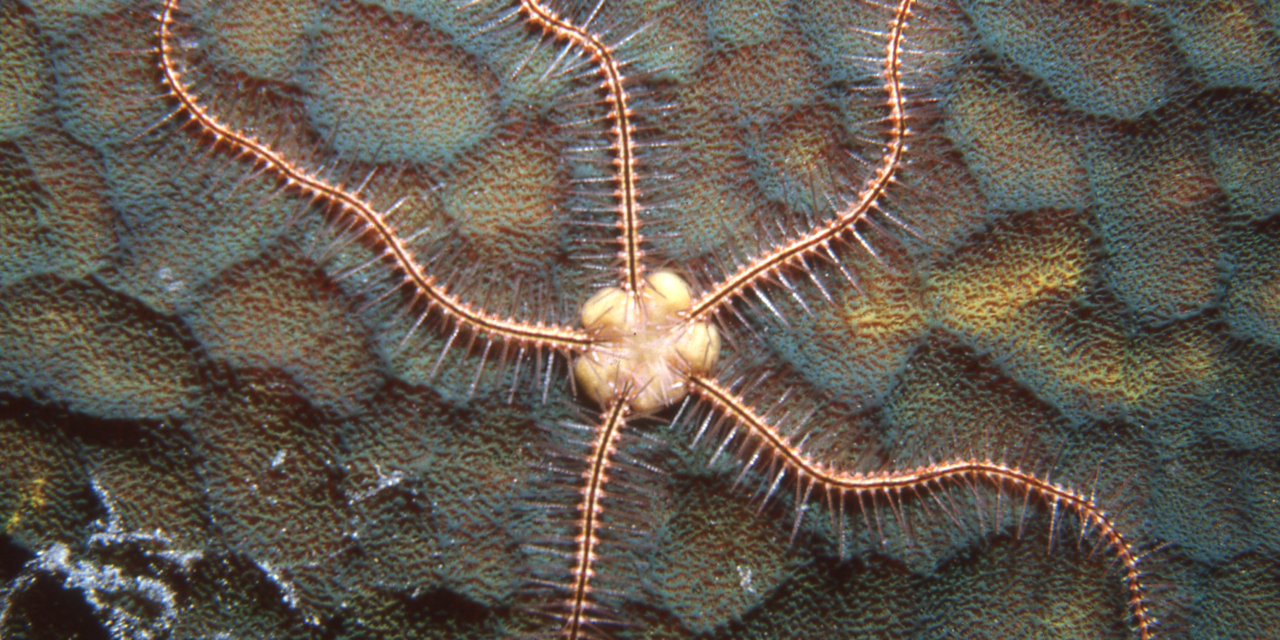
Brittle stars are slender-armed relatives of sea stars. They look delicate, but they are fast, flexible and surprisingly tough.
Did you know?
- Serpent stars. The class name, Ophiuroidea, comes from Greek words for “serpent” and “tail,” a nod to the snake-like arms.
- Why “brittle”? The arms of many species break off easily.
- Rowing, not crawling. Sea stars creep along on tube feet, but a brittle star pulls itself across the sea floor by whipping its arms, and it often clings to sponges, corals or other animals.
- Five arms, mostly. Nearly all have five long, slender arms that are clearly set apart from the central disk, though a few species have up to ten.
- An escape trick. If a predator attacks, a brittle star can easily cast off part of an arm and get away.
- Regrowing. An arm can be regenerated, taking a few months in warm tropical water but more than a year in cool water. The central disk has to stay intact, though. If it is completely separated from all the arms, the animal dies.
- Splitting in two. A few species can reproduce by splitting the central disk in half, and each half regrows into a complete animal.
- Sticky tube feet. Mucus on the tube feet can trap tiny plankton and other particles and pass them to the mouth, and some brittle stars loop small crustaceans or worms with their arms.
- Light and smell. Brittle stars can sense chemicals, touch and even light, and their tube feet help them detect light and odors.
- Glow in the dark. Several species are bioluminescent.

